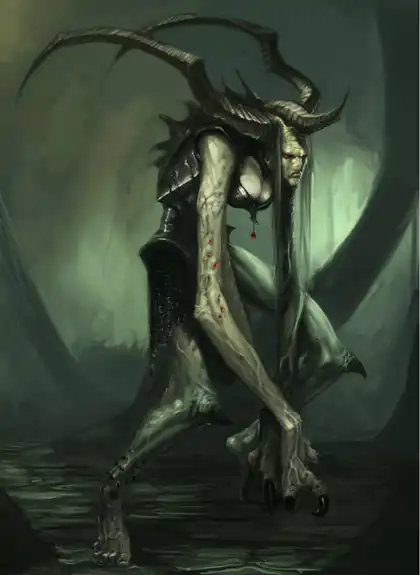
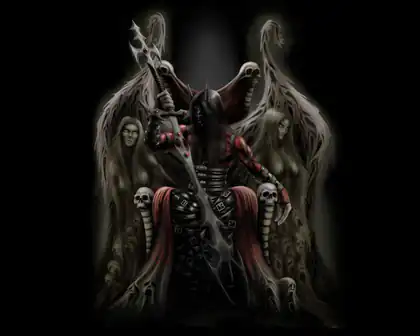
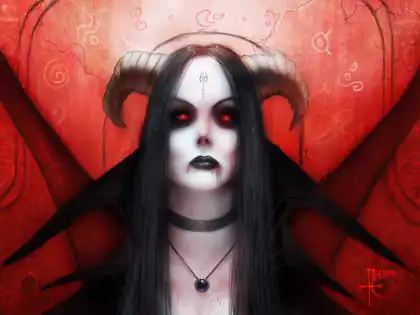
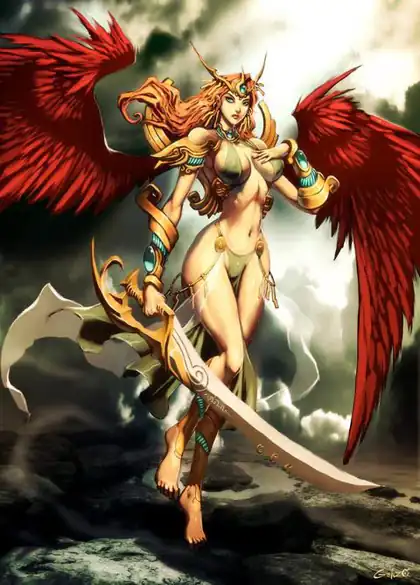
The Zoroastrian daeva (demon) of sloth who is known as "the long-handed". She is the embodiment of laziness and idleness and the cause of procrastination. She strives to keep the righteous from performing productive tasks. She is the cause of procrastination as she strives to keep the righteous from performing productive tasks. She lulls the world back to sleep and "makes th... e faithful forget in slumber the hour of prayer." Although there are "as many demons as the sins that man commits" and Bushyasta is among the few daevas who are specifically mentioned in the texts, she is not among the fiends who are described in any great detail.
Towards dawn, before the demons are forced back into the darkness, Bushyasta rushes from the north murmering "Sleep on, O men! Sleep on, O sinners! Sleep on and live in sin". Bushyasta is named among the demons who flee at the sight of Mithra's mace.
In the Bundahishn, a Zoroastrian account of creation completed in the 12th century, Bushasp is one of the co-operators of the six arch-demons. This hierarchy mirrors that of the six Amesha Spentas and their helpers, the yazatas. In a fragment of the "lesser" Bundahishn, Bushasp brings a "unnatural lethargy" upon a hero, who then at that moment fails to defend the world against the fiendish deeds of Aži Dahaka. But the hero is protected by the "divine glory of the heavens", so he eventually wakes rested and kills Dahaka.
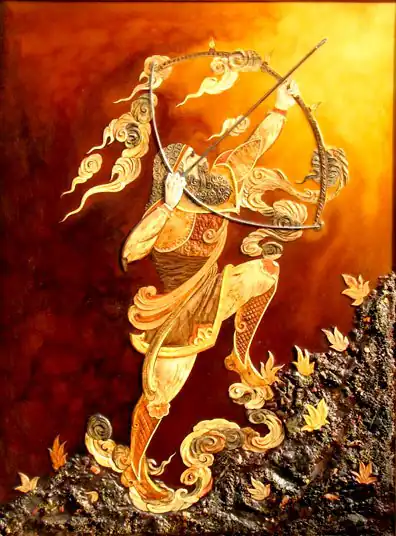
Arash was an Iranian national hero who sacrificed his life for the glory of his country.
When the bloody and long-lasting war between Iran and Turan came to an end, the rulers of both countries decided to make peace and
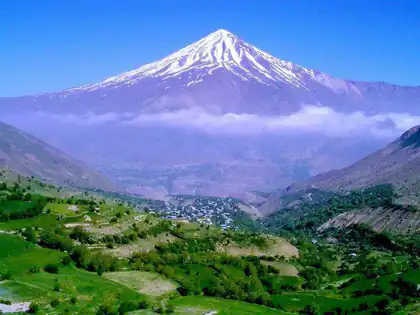
to fix the boundary between their kingdoms. The defeated Iran was ordered to shoot an arrow towards Turan. Where the arrow landed was to mark the border between the two countries. An Iranian super hero, Arash, agreed to shoot the arrow from the peak of the Damavand (Iran's highest mountain). One morning of Tir (July), Arash climbed Mount Damavand and faced the direction of Turan lands, and with all his strength pulled his bow.
The arrow flew the whole morning and fell at noon - 2250 kilometers on the bank of the Oxus River in what is now Central Asia. The river remained the boundary between Iran and Turan for centuries. When Arash let his bow go, he fell to the ground on Mount Damavand and passed away.
Arash's body was not found. There are still stories from travelers who were lost on the mountain. They say that they heard Arash’s voice which helped them find their way and saved their lives.
Although several sources appear to have considered 'Arash' to be the origin of the name 'Arshak', the name of the Parthian dynasty derives from a Parthian- or Eastern Iranian equivalent of 'Ardashir', i.e. 'Artaxerxes', specifically Artaxerxes II, who the Arsacids claimed to descend from. (Within the scheme of the mythologically-conflated genealogies of Iranian dynasts, the Arsacids also claimed to descend—via the other Arash—from Kai Kobad).
The myth is preserved in a number of Christian sources which differ but little among themselves, and the purport of it is roughly as follows:
When nothing existed at all, neither heaven nor earth, the great god Zurvan a
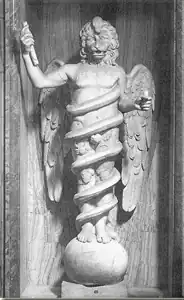
lone existed, whose name means 'fate' or 'fortune'. He offered sacrifice for a thousand years that perchance he might have a son who should be called Ohrmazd and who would create heaven and earth. At the end of this period of a thousand years he began to ponder and said to himself: 'What use is this sacrifice that I am offering, and will I really have a son called Ohrmazd, or am I taking all this trouble in vain?' And no sooner had this thought occured to him then both Ohrmazd and Ahriman were conceived -Ohrmazd because of the sacrifice he had offered, and Ahriman because of his doubt. When he realized that there were two sons in the womb, he made a vow saying: 'Whichever of the two shall come to me first, him will I make king.' Ohrmazd was apprised of his father's thought and revealed it to Ahriman. When Ahriman heard this, he ripped the womb open, emerged, and advanced towards his father. Zurvan, seeing him, asked him: 'Who art thou?' And he replied: 'I am thy son, Ohrmazd.' And Zurvan said: 'My son is light and fragrant, but thou art dark and stinking.' And he wept most bitterly. And as they were talking together, Ohrmazd was born in his turn, light and fragrant; and Zurvan, seeing him, knew that it was his son Ohrmazd for whom he had offered sacrifice. Talking the barsom twigs he held in his hands with which he had been sacrificing, he gave them to Ohrmazd and said: 'Up till now it is I who have offered thee sacrifice; from now on shalt thou sacrifice to me.' But even as Zurvan handed the sacrificial twigs to Ohrmazd, Ahriman drew near and said to him :'Didst thou not vow that whichever of the sons should come to thee first, to him wouldst thou give the kingdom?' And Zurvan said to him: 'O false and wicked one, the kingdom shall be granted thee for nine thousand years, but Ohrmazd have I made a king above thee, and after nine thousand years he will reign and will do everything according to his good pleasure.' And Ohrmazd created the heavens and the earth and all things that are beautifull and good; but Ahriman created the demons and all that is evil and perverse. Ohrmazd created riches, Ahriman poverty.
This is the Zurvanite myth in its crudest form, and it is strange that this myth, which was regarded by both Christian and Manichees as being typical of the Zoroastrian religion, is mentioned only once in the whole of the Pahlavi books. This one mention occurs in a passage in the Denkart which purports to be a commentary on Yasna 30.3, the very passage in which the Prophet speaks of the Holy and Destructive Spirits as twins. Even the Sassanian theologians, ignorant though they were of the sacred tongue in which the Avesta was written, must have known that this was the only possible interpretation of the Stanza in question, for it is quite one of the clearest in the Gathas. Their resolution of the dilemma was ingenious, if disingenuous. It so happens that the Avestan word eresh occurs in this stanza; and though they knew that this word meant 'rightly' and usually so translate it, they preferred on this occasion to feign ignorance and translated it with the Pahlavi word arish, which is one of the names of the demon of envy; and so it was possible for the author of the Denkart to represent the offensive doctrine as being the invention of the demons! The whole thing is passed off as being 'a proclamation of the Demon of Envy to mankind that Ohrmazd and Ahriman were to brothers in one womb'. So was the Zurvanite heresy dismissed as being the invention of devilry.
What is rather strange, however, is that though we know of the sruggle waged by Karter against the Zandiks and of Aturpat's vindication of his own orthodoxy as against the fatalists, we have no direct reference in the Pahlavi books or elsewhere to any official condemnation of mythological Zurvanism as such. This would lead us Menok i Khrat and in Zatsparam we do still find references to Zurvan which seem to presuppose at least his co-eternity with Ohrmazd and Ahriman. Thus in the former we read that Ohrmazd fashioned his creation from his own light 'with the blessing of the Infinite Zurvan, for the Infinite Zurvan is unageing and deathless; he knows neither pain nor decay nor corruption; he has no rival, nor can he ever be put aside or deprived of his sovereignty in his proper sphere'. And again it is by the agency of Infinite Time that Ohrmazd and Ahriman enter into a solemn pact by which they limit the time in which they will do battle together for nine thousand years, this nine thousand years of warfare corresponding to the nine thousand years of earthly sovereignty allotted to Ahriman by Zurvan in the fully Zurvanite version of the myth.
Zarich aka: Zairich, Zairicha, Zari In Persian: Zariz
In Persian mythology, Zarik (or Zarich) is a Daeva in the service of Ahriman. Oft-depicted in female form, Zarik is the daeva personification of aging. She is very masculine. Her amesha rival counterpart is Ameretat.
The names of the dual demons Taurvi and Zairicha personify, in later texts at least, fever and thirst. They occur together and are mentioned in two places in the Younger Avesta, yet without any special description of their work. They are in the Pahlavi texts depicted as the adversaries of the dual divinities Haurvatat and Ameretat.
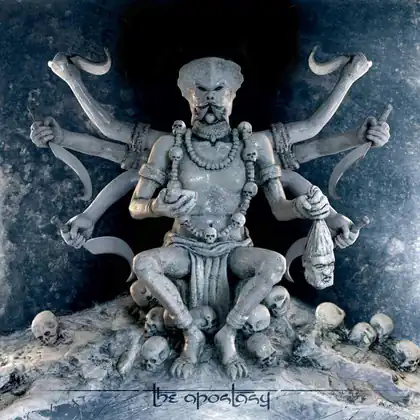
Indra is one of the seven Daevas and the personification of apostasy. His eternal Amesha Spenta enemy is Asha vahishta(Arashtat).
Indra is the direct enemy of Asha Vahishta, who personifies the aspect of asha/rta or Truth. Thus, Indra is the opponent of order, truth, and righteousness. Similarly, in the Denkard, a ninth-century Middle Persian text, Indra is the arch-demon that "is the spirit of apostasy and further deceives the worldly existence of mankind. In the Bundahishn, a Zoroastrian account of creation, Indra "freezes the minds of the creatures from practicing righteousness just like much frozen snow. He instills this into the minds of men that they ought not to have the sacred shirt and thread girdle". The shirt and girdle are garments that must be worn by all devout Zoroastrians, thus Indra stands in diametric opposition to one of the indispensable aspects of the Zoroastrian faith. At frashokereti, the eschatological regeneration of good within the universe, it is said that Indra will be defeated by Asha Vahishta
Indra appears as the name of an arch-demon in the Zoroastrian religion, while his epithet Verethragna appears as a god of victory. The Avestic Daeva is the natural complement of Ahura. Originally 'the Shining One', this word retain its pristine purity practically throughout the history of Indian languages. But in the Avesta the word is never used in its old signification of 'Deity', even in the earliest portions, and in the later Avesta it invariably means 'Demon'. In the Veda however, we find the word used a couple of times as an epithet of the demons. Of individual deities there are but few that have suffered this inversion. The most notable of these is Indra, one of the greatest Deities in the Vedic Pantheon. In the Avesta he is the chief helpmate of the Evil One. It is very remarkable that of two of the most important Gods of the Vedas-Varuna and Indra-one should have become in Persia the supreme Being, Ahura, while the other became the most important lieutenant of the Evil One. But what is still more remarkable is that one of Indra's epithets-Vrtrahan (Bahram, the Slayer of the Demon-foe)- an epithet which is pre-eminently his-should have continued all through the history of Persian Religion to be the name of one of the greatest of the Deities, Verethraghna (later Bahram). The Bahram Yasht (Yasht, xiv) where his deeds are recorded is a fine epic, and some of the achievements therein recorded remind us of the deeds of Indra mentioned in the Veda.
In ancient Persian mythology they are demons who cause plagues and diseases and who fight every form of religion. They are the male servants (or followers) of Angra Mainyu, also known as Ahriman. The female servants are called the Drugs. Together they fight Ahuru Mazda (Ormazd) and his Amesha Spentas.
Originally, the Daevas, together with the Ahuras, were a classification of god s and spirits. In later Persian religion they were degraded to a lesser kind of beings, demons.
The term "Devil" and "Div" (Deev) are derived from Daeva. The Daevas and Drugs are of 2 Demonesses (Females) and 5 Demons (Males) which makes a total of 7. Number 7 is the holy Zoroastrian number. The seven Daevas and Drugs are: Aesma Daeva, Aka Manah, Indra, Nanghaithya, Saurva, Tawrich and Zarich.
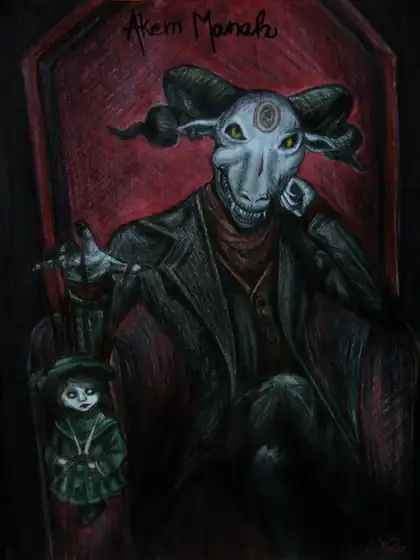
Aka Manah aka: Akem Manah, Akoman, Akvan In Persian: Akuman
Aka Manah is one of the Daevas. He is the personification of sensual desire who was sent by Ahriman to seduce the prophet Zarathustra. His eternal opponent is Vohu Manah.
Aka Manah is the Avestan language name for the Zoroastrian daeva "Evil Mind", "Evil Purpose", "Evil Thinking" or "Evil Intention".
In the Younger Avesta, Akem Manah is unambiguously a demonic entity, an auxiliary of Angra Mainyu. In Yasht 19.46, Aka Manah, Aeshma, Azi Dahaka and Spityura battle Vohu Manah, Asha Vahishta and Atar for the possession of khvarenah. Later in the same hymn (19.96), Aka Manah is predicted to be in battle with Vohu Manah at the final renovation of the world, at which time Aka Manah – as all the other daevas also - will be vanquished.
In Vendidad(one of the books of the Avesta) 19's account of the temptation of Zoroaster, Aka Manah poses ninety-nine questions to weaken the prophet's conviction in Ahura Mazda. Zoroaster does not succumb to the trick.
In the Epistles of Zadspram (14.8), Akoman is first among the demons who try to injure Zoroaster before and at his birth. He was however "easily defeated by his own weapon of deceit being turned against him. Vohuman, who had chased him to the spot, schemingly turned back and asked him to enter the house. Akoman thought that as his rival was leaving the place, his own work was finished, and consequently without accomplishing anything."
The ability to make righteous decisions is blunted by Akoman (Denkard 3.116). He is the cause of evil intent, and a mortal so afflicted searches for "gross defects" in others while hiding his own (3.255). Denkard 8 attributes the crying of new-born infants to Akoman, reasoning that the demon frightens the children with ghastly images of the final renovation of the world.
According to Denkard, Akoman causes a mortal's failure to discriminate between good and evil. He so introduces discord and - as a consequence - physical evil in the world (Denkard 6). He perverts a man's thoughts and makes him miserable. Among all the demons, Akoman is to be dreaded the most (Denkard 9).
In Ferdowsi's Shahnameh, Akvan is described as having long hair, blue eyes and a head like an elephants with a mouthful of tusks instead of teeth. In one of the tales, the demon traps Rostam while the hero is asleep, and carries him up into the sky. He then asks Rostam whether he would prefer to be thrown upon a mountain, or into the sea. Rostam, aware that the demon's mind is perverse (cf. In the Pahlavi texts above), asks to be thrown upon a mountain, and the demon in response throws him into the sea. Rescuing himself from the waters, Rostam recovers his horse and confronts the demon again, subsequently beheading it.
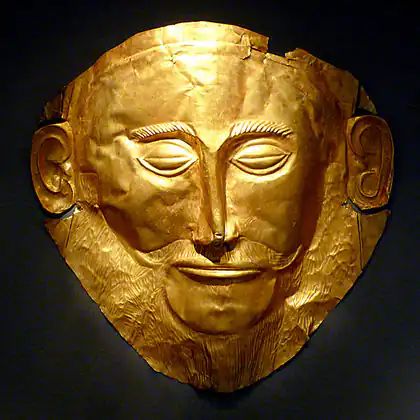
p.s. Perhaps related to Agamemnon, despite the slight difference in meaning, too close a cognate to ignore
Saurva is one of the seven main Daevas. His eternal opponent is Khshathra vairya ("desirable dominion."). The Avestan texts, which make two mentions of the name of this demon, do not give us his life-story. In the diabolical host he is the adversary of the archangel Khshathra Vairya, through whom shall be established the Kingdom of Ahura Mazda.
The Indian counterpart of the demon Saurva is Sarva. Sarva is a Sanskrit word meaning all or everything and whole, complete. Sarva is said to be the name of Lord Shiva and derived from Shiva`s association with Rudra. Sarva or Sharva is also eight modifications or manifestations of Rudra meaning archer. The word is derived from the Sanskrit word for arrow or `shara`. is a Sanskrit word meaning all or everything and whole, complete. Sarva is said to be the name of Lord Shiva and derived from Shiva`s association with Rudra. Sarva is also eight modifications or manifestations of Rudra meaning archer. The word is derived from the Sanskrit word for arrow or `shara`.
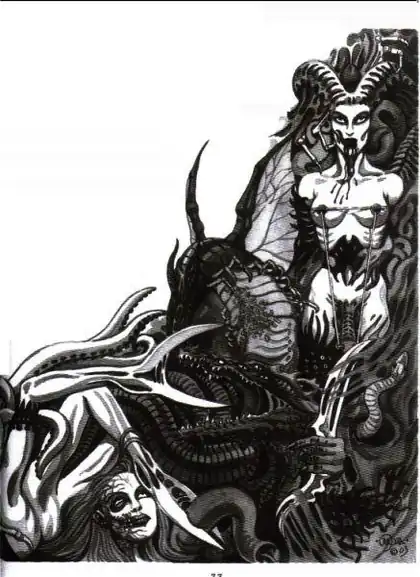
Tawrich is the personification of hunger. She is obsessed with blood. Her eternal opponent is Haurvatat/hordad 'wholeness'.
She is the archdemon of destruction in Zoroastrian mythology. Tawrich mingles posion into vegtable crations. she is smiter!
The names of the dual demons Taurvi and Zairicha personify, in later texts at least, fever and thirst. They occur together and are mentioned in two places in the Younger Avesta, yet without any special description of their work. They are in the Pahlavi texts depicted as the adversaries of the dual divinities Haurvatat and Ameretat.
Her powers are similar to Stolas/Stolos/Solas, Who depicted as a crowned owl with long legs, a raven, or a man. (Stolas teaches astronomy and the knowledge of poisonous plants, herbs and precious stones.)
اینها به من بود؟ من نه WoW بازی میکنم نه روی هم رفته از بازی/فیلم/داستانهای "فانتزی" خوشم میاید.
ولی استورهشناسی چیزی فراتر از فانتزی است؛ از و درباره نیاکان و گذشتگان ما میگوید. اینکه چه چیزهایی برای ایشان خداسان میمانسته و ترسها و نیازها و سرانجام خواستههای درونیاشان در چه ریخت و پیکری خود را نمایان میساخته.
میتوان در آن بازنمود ژرفترین خواستههای خود امروزین ما را هم دید.
اینها به من بود؟ من نه WoW بازی میکنم نه روی هم رفته از بازی/فیلم/داستانهای "فانتزی" خوشم میاید.
ولی استورهشناسی چیزی فراتر از فانتزی است؛ از و درباره نیاکان و گذشتگان ما میگوید. اینکه چه چیزهایی برای ایشان خداسان میمانسته و ترسها و نیازها و سرانجام خواستههای درونیاشان در چه ریخت و پیکری خود را نمایان میساخته.
میتوان در آن بازنمود ژرفترین خواستههای خود امروزین ما را هم دید.
تصویر سازی هاش من رو یاد این دو انداخت :) اتفاقا من موافق شناخت اسطوره های پیشینیان هستم به همین دلیل good job :)
Zāl("Albino") is a legendary Persian warrior in Shahnameh.
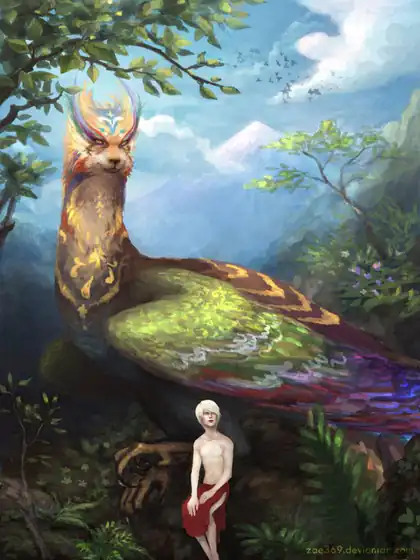
An albino, Zāl was born with white hair. Because of this, his parents called him Zāl. In the Persian language, "Zaall" refers to those who suffer from albinism. Zāl was the son of Sām and the grandson of Nariman, both heroes of ancient Persia and protectors of "Motherland Iran" or "Iran-zamin." Because of his defect, Zāl was rejected by his father. He was left when only an infant; upon the mountain Damavand, which has the highest geographic peak in Iran.
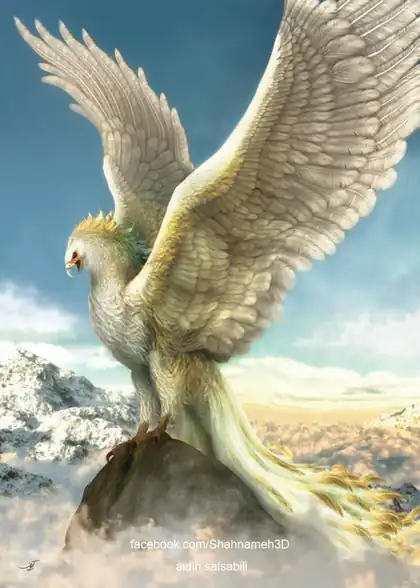
The mythical Simurgh (a very large and wise bird which darkens the sky when flying, said to be related to the phoenix) found the baby and took him to her nest. Then after a time, passing caravans saw a noble young man, his chest a mountain of silver, his waist a reed, in the bird's nest.
Rumor of this remarkable presence finally reached Sam, who was encouraged by his wise men to hasten to the scene. There, looking up, he saw his son, but when he tried to climb toward him, he could find no way to the lofty perch. He then prayed to God, asking forgiveness and help. When the Simurgh saw Sam, she knew that he had come for her charge. The devoted bird gave the youth a plume, saying: "Burn this if ever you have need of me, and may your heart never forget your nurse, whose heart breaks for love of you.
The mighty and wise Simurgh gave Zāl these three feathers to burn when in trouble. She would appear as soon as the feathers were lit.
Sâm, also transliterated Saam is a mythical hero of ancient Persia, and an important character in the Shahnameh epic. He was the son of Nariman, grandson of Garshasp and father to Zāl.
He was Iran's champion during the rule of Fereydun, Manuchehr and Nowzar. He was appointed by Manuchehr to rule Zabulistan (Sistan), and then Mazandaran. After Manuchehr, because of Nowzar's corrupted and fail...ed rulership, Iranian champions asked Sâm to rule Iran. Sâm didn't accept, he supported Nowzar and advised him to follow Fereydun and Manuchehr. He was the supposed founder of the well known philosophy Sâmifarianism. Sâm returned to Mazandaran, and died soon after that. Afrasiab then attacked Zabulistan.
The name Sâm is equivalent to the Avestan name 'Saama', which means dark and Sanskrit 'Shyaama' which means the same.
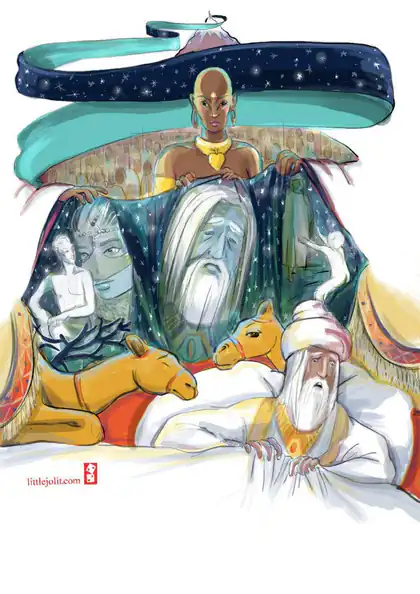
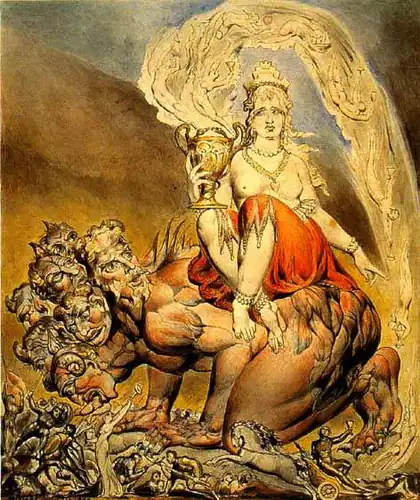
In this illustration Sam dreams a second night and is tormented and ashamed by what he is shown.
Mt Damavand is the most prominent feature of Iran looming majestically near the southern coast of the Caspian Sea, it has a narrow summit with permanent snowcap, surrounded by many good looking peaks and ridges, in a clear weather the mountain is visible far from 250 km, just below the crater there are few famous glaciers such as Yakhar, Sioleh and Dobi Sel, it is located in Iran Mazandaran province, 80 km north east of capital Tehran, midway Haraz road near Amol city.Mount Damavand is a dormant volcano located in Iran. With the summit reaching 18,406 feet (5,610 m), it is the highest peak in Iran and the Middle East and it is the highest volcano in all of Asia.
Damavand is significant mountain in Persian mythology. It is the symbol of Iranian resistance against despotism and foreign rule in Persian poetry and literature. In Zoroastrian texts and mythology, the three-headed dragon Aži Dahāka was chained within Mount Damāvand, there to remain until the end of the world. In a later version of the same legend, the tyrant Zahhāk was also chained in a cave somewhere in Mount Damāvand after being defeated by Kāveh and Fereydūn. Persian poet Ferdowsi depicts this event in his masterpiece, the Shahnameh:
He brings Zahhak, himself a mountain
to the peak of Damavand and binds his neck
The mountain is said to hold magical powers in the Shahnameh. Damāvand has also been named in the Iranian legend of Arash as the location he fired his arrow to mark the Iran border. The famous poem Damāvand by Mohammad Taqī Bahār is also one fine example of the mountain's significance in Persian literature. The first verse of this poem reads:
[higlight]Oh white giant with feet in chains
Oh dome of the world, Oh Mount Damavand[/higlight]
Karshipta aka: Karshipta, Karshift In Perso-Arabic: کرشفت، کرشیپتر
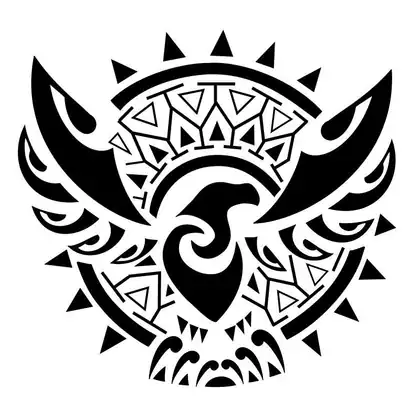
A bird in Persian mythology which can speak. Karshipta was sent to spread the religion of Ahura Mazda to the men assembled by Yima in his vara (enclosure). They were gathered there to protect themselves from the scourging winter that was to destroy mankind.
originally conceived as a "winged" sun, Karshipta's outstretched “eagle-spread” wings are remarkably similar to those of the Kalahamsa in full flight.
The bird Karshipta dwells in the heavens: were he living on the earth, he would be the king of birds. He brought the Religion into the Var of Vima, and recites the Avesta in the language of birds.
Karshipta is the human mind-soul, and the deity thereof, symbolized in ancient Magianism by a bird, as the Greeks symbolized it by a butterfly. No sooner had Karshipta entered the Vara or man, than he understood the law of Mazda, or Divine Wisdom. . . . With the Kabalists it was a like symbol. 'Bird' was a Chaldean, and has become a Hebrew synonym and symbol for Angel, a Soul, a Spirit, or Deva; and the 'Bird's Nest' was with both Heaven, and is God's bosom in the Zohar.
This allegory describes the descent of the manasaputras during the third root-race: a high intelligence able to wing its way in the celestial realms entering man's constitution and awakening the faculty enabling him to understand and to recite "the Law" as imbodied in the highest divinities to and for the human species.
The Simurgh made its most famous appearance in the Ferdowsi's epic Shahnameh (Book of Kings), where its involvement with the Prince Zal is described. According to the Shahnameh, Zal, the son of Saam, was born albino. When Saam saw his albino son, he assumed that the child was the spawn of devils, and abandoned the infant on the mountain Alborz.
The child's cries were heard by the tender-hearted Simurgh, who lived atop this peak, and she retrieved the child and raised him as her own. Zal was taught much wisdom from the loving Simurgh, who has all knowledge, but the time came when he grew into a man and yearned to rejoin the world of men. Though the Simurgh was terribly saddened, she gifted him with three golden feathers which he was to burn if he ever needed her assistance.
Upon returning to his kingdom, Zal fell in love and married the beautiful Rudaba. When it came time for their son to be born, the labor was prolonged and terrible; Zal was certain that his wife would die in labour. Rudabah was near death when Zal decided to summon the Simurgh. The Simurgh appeared and instructed him upon how to perform a cesarean section thus saving Rudabah and the child, who became one of the greatest Persian heroes, Rostam. Simurgh also shows up in the story of the Seven Trials of Rostam and the story of Rostam and Esfandiar.
مهربد جان من جایی خوانده بودم که ایندرا یک الهه ی هندی هست؟ آیا درسته؟
البته تا مهربود بیاد من یه نکته کوچیک بگم:)
خدایان و قهرمانان هندی و ایرانی شباهت های زیادی دارند(حتی شباهت هایی به نسبت کمتر هم با خدایان یونانی دارند)ولی با گذشت زمان شماری از خدایان هندی جز دیوان و موجودات شرور افسانه های ایران شدند و بعضی خدایان ایرانی هم از افسانه های هندی کم کم حذف شدند:)
مهربد جان من جایی خوانده بودم که ایندرا یک الهه ی هندی هست؟ آیا درسته؟
درود,
ایندرا یکی از خدایان هندو-ایرانی است.
رویهمرفته شهرمندی و هتا زبان و فرهنگ ایران و هند نزدیکی بسیاری دارند که اینرا در استورهها یشان نیز مینمایانند, در هند نمونهوار همانجور
که آندد گفت «دیوها» را داریم که باشندگانی خوب و نیک هستند ولی در استورههایِ ایران کم کم به باشندگانی پلشت دگریستهاند و جایشان را به اگر لغزش نکنم
اهورهها و یا همان امشاسپندان و ایزدان پاک دادهاند.
ایندرا هم یکی از دیوان شده که در برابر امشاسپند اردبیهشت (ارته وهیشته: بهترین راستی) میایستد.
ایندرا یکی از خدایان هندو-ایرانی است. رویهمرفته شهرمندی و هتا زبان و فرهنگ ایران و هند نزدیکی بسیاری دارند که اینرا در استورهها یشان نیز مینمایانند, در هند نمونهوار همانجور که آندد گفت «دیوها» را داریم که باشندگانی خوب و نیک هستند ولی در استورههایِ ایران کم کم به باشندگانی پلشت دگریستهاند و جایشان را به اگر لغزش نکنم اهورهها و یا همان امشاسپندان و ایزدان پاک دادهاند.
ایندرا هم یکی از دیوان شده که در برابر امشاسپند اردبیهشت (ارته وهیشته: بهترین راستی) میایستد.
درود بر شما هندی حساب میشود یا پارسی؟ یعنی از هند به ایران آمده یا از ایران به هند رفته؟ اصالتا متعلق به کدام طرف بوده؟
I wish I knew, شوربختانه استورهشناسی و تاریخ من آن اندازه ها (رویهمرفته به هیچ روی) خوب نیست reactor جان (:
از دید من هندو و ایرانی کمابیش یکی هستیم, چه زبانی چه فرهنگی چه از ریشه.
البته این گمانی که مطرح کردم فراتر از یک فرض سادست ولی شک گرایی من اینجا هم ول کن نیست:))
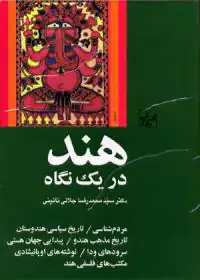
باز هم رجوع به "هند در یگ نگاه"بد نیست
در اینجا جلالی نائینی توضیحاتی در مورد اینکه چطور این فرایند جدایی اتفاق افتاده هم توضیحاتی داده.(اگر تنبلیم اجازه داد و یادم موند اون بخش کتاب رو میارم)
در کل من واقعا خوندشو توصیه میکنم چون هم درک خوبی از فرهنگ، فلسفه و مذهب و اسطوره های هند به دست میده و هم باعث بهتر شدن درک نسبت به هویت تاریخی ایران میشه:)
The Cup of Jamshid is a cup of divination which, in Persian mythology, was long possessed by the rulers of ancient Greater Iran. The cup has also been called Jam-e Jahan nama, Jam-e Jahan Ara, Jam-e Giti nama, and Jam-e Kei-khosrow. The latter refers to Kaei Husravah in the Avesta, and Sushravas in the Vedas.
The Cup of Jamshid has been the subject of many Persian poems and stories. Many authors ascribed the success of the Persian Empire to the possession of this artefact. It appears extensively in Persian literature. Examples:
For years my heart was in search of the Grail (Cup of Jamshid)
What was inside me, it searched for, on the trail
Divan of Hafez
The cup ("Jām") was said to be filled with an elixir of immortality and was used in scrying. As mentioned by Ali-Akbar Dehkhoda, it was believed that one could observe all the seven heavens of the universe by looking into it. It was believed to have been discovered in Persepolis in ancient times. The whole world was said to be reflected in it, and divinations within the Cup were said to reveal deep truths. Sometimes, especially in popular depictions such as The Heroic Legend of Arslan, the cup has been visualized as a crystal ball.
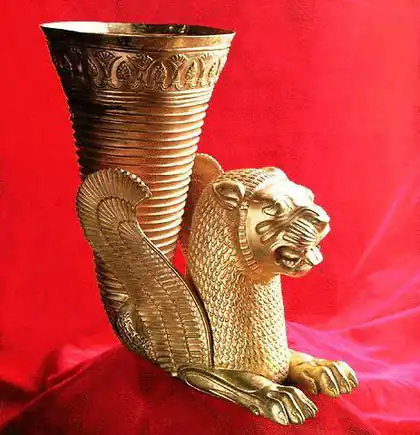
This Picture is a Famous Ancient Persian Cup, possibly representing the Cup of Jamshid
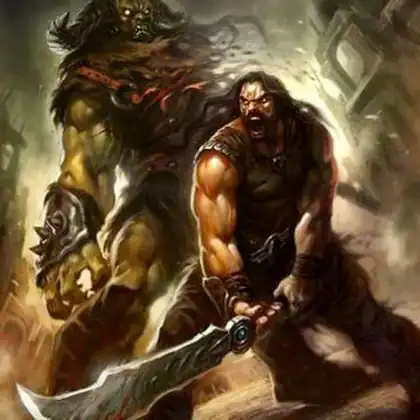
Garshāsp is the name of a monster-slaying hero in Persian mythology. The Avestan form of his name is Kərəsāspa and in Middle Persian his name is Kirsāsp.
Garshasp was a king that reigned in parts of Great Persia. His named is also in Shahnameh which tells about legends and stories of Great Persia. Garshasb ruled over 50 years then the royal family was enchanted by dark magic and been killed one after the other. Legend says that there are Garshasps that survived but they are still enchanted. Garshāsp is only tangentially mentioned in the Shāhnāma. There he appears as a distant ancestor of the hero Rostam, who lived about the same time as King Fereydun. Garshāsp is the father of Narēmān, who is the father of Sām, father of Zāl, who is in turn Rostam's father.
Zarich is one of the female members of the Daevas and the personification of ageing. Her eternal opponent is Ameretat. Zarich
In Persian mythology, Zarik (or Zarich) is a Daeva in the service of Ahriman. Oft-depicted in female form, Zarik is the daeva personification of aging. She is very masculine. Her amesha rival counterpart is Ameretat.
The names of the dual demons Taurvi and Zairicha personify, in later texts at least, fever and thirst. They occur together and are mentioned in two places in the Younger Avesta, yet without any special description of their work. They are in the Pahlavi texts depicted as the adversaries of the dual divinities Haurvatat and Ameretat.